
The AI question that's not being asked
Updated: Aug 1
I know you know. Artificial Intelligence is dominating boardroom conversations. Every leadership team seems to be asking the same question. "How can we use AI to improve productivity, efficiency and save us money".
It's an understandable question. AI is moving incredibly quickly and nobody wants to be left behind. Every business I'm speaking to is developing AI systems to improve operational effectiveness, mitigate risk and enhance their capabilities.
But I wonder whether it's the wrong place to start. Let's be honest. Technology has never been the source of competitive advantage - and at the speed of the development and adoption of AI, AI itself will not be (Generative AI reached 53% population adoption within three years, faster than the PC or the internet - source: Stanford 2026 AI Index Report). But creating value for customers has and always will be the competitive advantage.
Except we often fail to build that into our thinking.

History has been here before When I speak about AI, I often use three classic examples. Kodak. Blockbuster. Nokia.
These brands weren't short of talented people or technology. They weren't lacking investment. In Kodak's case, they even invented the digital camera that eventually killed them.
No. The problem wasn't technology. The problem was that they became focused on protecting what they had rather than understanding how customer expectations were changing. They were about exploitation. Not exploration. They did not ask the question: how can we create more value for customers.
Kodak believed they were in the film business. They had large amounts of revenue being generated by film processing. Their customers campe to them to help capture memories. Thats where the value lay. And when the digital technology helped them capture memories in a more valuable way, they shifted.
Blockbuster believed they rented out DVDs. Their model grew on the back of fining customers for overdue rentals. Customers wanted convenient entertainment. Netflix killed them when they introduced ways customers were not fined. Then used the revenue gained from that to build a new tech platform.
Nokia dominated the market with practical mobile phones (I used to love my 3210 back in the early 00s!). When Apple launched the iPhone, Nokia abandoned low cost practical phones and attempted to copy Apple. But they left behind why customers bought from them. Consumers had no alternative than the highly priced pocket computers - and Nokia was late to that party. The practical low cost option had gone. And so Nokia failed.
In each case, the companies lost sight of the value customers were really looking for from them.
AI is creating another one of these moments. Today I see many organisations making a similar mistake. They are building AI features because everyone else is. They are launching AI assistants because competitors have one. They are talking about models, agents and automation because those are the fashionable conversations. Productivity is the key word.
None of those things are strategies though. They are capabilities. Exploitations of what is there.
The strategic question is still the same as it has always been:
How does this create more value for our customer?
If you can't answer that clearly, AI probably isn't solving the right problem.
A different way of thinking
For years, many organisations have worked with an industrial mindset.
Build a product. Sell the product. Find customers.
I believe AI demands something different. Based on brand thinking I'd recommend starting - not with what you do - but with the customer. Understand what they are trying to achieve. Their problems. What they want to become. Identify where value can be created. Then ask how AI can help you deliver that value in a way that was previously impossible.
It's a subtle shift. But it changes everything.
The opportunity for leaders
Peter Drucker famously said:
"The purpose of business is to create and keep a customer."
That statement feels just as relevant today as it did decades ago. The organisations that succeed over the next decade won't necessarily be those using the most AI.
They will be the ones that understand their customers best and use AI with purpose.
Technology will continue to change. Customer value remains remarkably constant.
So perhaps the question for your next leadership meeting shouldn't be:
"What's our AI strategy?"
Instead ask:
What unique value could we now create for our customers because AI exists?
I suspect the answers to that question will be far more interesting.
Examples
So here are a few examples of brands who have asked the question about customer value. I add them here for your inspiration:

Spotify – AI DJ
Spotify has introduced an AI DJ that creates a personalised soundtrack for every listener. Rather than simply recommending songs, it curates playlists, introduces new artists and adapts to your tastes over time. The result is a music experience that feels far more personal and engaging.

Duolingo – AI Learning
Duolingo Max uses AI to make language learning feel like working with a personal tutor. Learners can roleplay real-world conversations and even have AI-powered video calls to practise speaking in realistic scenarios. It transforms learning from passive exercises into interactive coaching.

Tesla – AI Driver Assistance
Tesla uses AI to power advanced driver assistance and autonomous driving capabilities. By continuously analysing data from millions of journeys, the system becomes smarter over time, helping drivers navigate roads more safely and with greater confidence.

Airbnb – AI Concierge
Airbnb is using AI as a digital concierge, providing personalised recommendations, helping guests plan trips and supporting both travellers and hosts throughout their stay. Rather than simply booking accommodation, the platform helps create a smoother end-to-end travel experience.

Michelin – Connected Fleet
Michelin has gone far beyond manufacturing tyres. Its Connected Fleet platform uses AI to analyse vehicle, tyre and driving data, predicting tyre failures before they happen and helping fleet operators improve safety, reduce downtime and lower operating costs.

Hilton – Connected Rooms
Hilton is creating connected hotel rooms that remember guest preferences across its properties. Lighting, temperature and other room settings can automatically adapt to returning guests, creating a more personalised and seamless hotel experience.
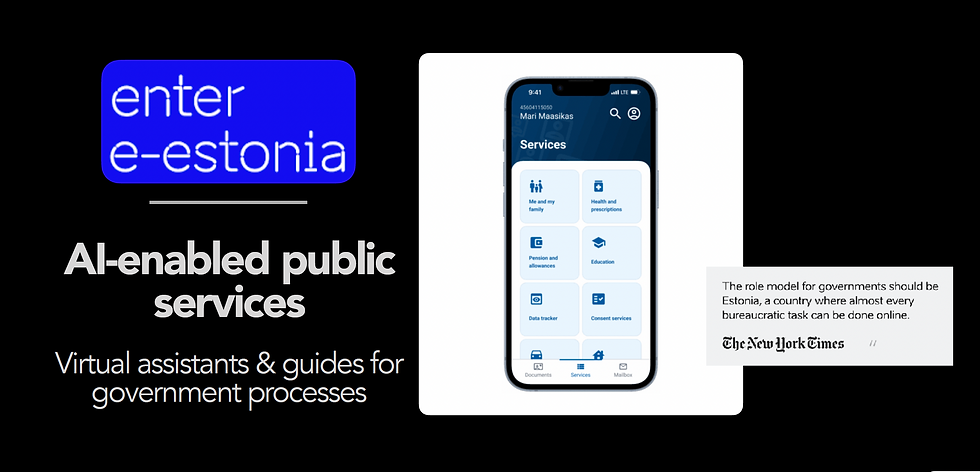
Estonia – AI-Enabled Public Services
Estonia is using AI to simplify government / citizen interactions (take note UK goverment!). Virtual assistants and digital guides help citizens navigate public services and complete government processes online, making interactions with the state faster, simpler and more accessible.
NHS – AI Diagnosis Prioritisation

The NHS is increasingly using AI to analyse medical images such as X-rays, CT scans and MRIs. Rather than replacing clinicians, AI helps prioritise urgent cases and supports earlier diagnosis, enabling patients to receive treatment more quickly.
Ask the right questions
AI is changing the tools available to every organisation. That's exciting.
But tools have never been enough.
The organisations that win over the next decade won't simply automate yesterday's business model. They'll use AI to create entirely new forms of customer value. And when brands appreciate they need to now not only speak to a customer but to the cusotmers agent AND the customer - an agent who will be verifying and checking out the value on offer - suddenly this gets even more interesting. That's why we need brand thinking. That's why we need brand leadership.
Don't start your next AI conversation by asking what AI can do.
Start by asking what your customers need.
Everything else follows from there.


When a project needs a central spot for notes and pages, a shared editing space can reduce the back-and-forth of scattered documents.
When you are mapping out audio file formats or tagging conventions, this guide to track data can act as a handy reference. It covers the core points in a compact format that suits quick consultation.
If you enjoy learning in small, focused increments, EduChips provides a thoughtful structure for that approach. The page highlights how teachers and lifelong learners can benefit from short, actionable insights. I appreciate that EduChips emphasizes practical skills over passive reading, which makes it easier to apply what you learn in real-world settings.
The article rightly points out that we often focus on what AI can do rather than what it should do. This reminds me of the infrastructure behind these systems, and how the choices made there also carry ethical weight. For anyone curious about the technical side, a server administration perspective offers practical notes on managing the hardware that powers such tools.
The AI question is indeed complex, as it forces us to rethink the very nature of human creativity and output. As we integrate these tools, managing the resulting digital footprint becomes increasingly difficult for creators. Adopting a unified navigation hub allows professionals to direct their audience effectively without cluttering their main profiles. It is a necessary step for anyone looking to maintain clarity in an automated world.